Types of Hearing Aids in Fairbanks, AK

Hearing aids can improve communication, confidence, and quality of life by helping you follow conversations and stay engaged in social settings. Better access to sound also supports brain health by reducing listening effort and helping the brain stay active and connected. After a hearing test, we’ll discuss the hearing aid options best suited to your needs, lifestyle, and treatment goals.

How Hearing Aids Help

Hearing aids work by using tiny microphones to capture sounds from your environment. Those sounds are then processed and customized based on your hearing needs before being delivered through a small speaker, called a receiver, into your ear. This allows important sounds—particularly speech—to be heard more clearly and comfortably. This extra clarity often cuts down on stress and fatigue, letting you enjoy life more fully.

Different Styles of Hearing Aids: Finding the Best Fit for You

Hearing aids are not a one-size-fits-all solution. They are available in a variety of styles, including models that fit behind the ear and others that sit discreetly within the ear canal. The most appropriate option depends on several factors, including the degree and type of hearing loss, ear anatomy, communication needs, lifestyle, dexterity, and personal preferences.

Following a comprehensive hearing evaluation and discussion of your hearing goals, your audiologist will recommend hearing aid styles and technology levels that best support your hearing, communication, and overall quality of life.

Our team will work with you to find the right match from a range of options, including: 

Behind-the-Ear (BTE)

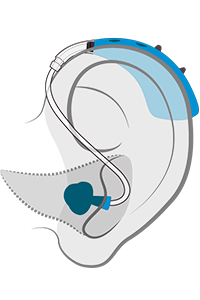
A behind-the-ear (BTE) hearing aid sits comfortably over the top of your ear, with the main components—including the battery, microphones, and digital processor, and speaker/receiver—housed in the portion that rests behind the ear. It connects to a hook and a plastic tube that leads to a custom-made earpiece, which fits in your ear canal and delivers sound directly to your auditory system. BTE hearing aids are suitable for people of all ages with moderate to severe hearing loss and are especially beneficial for children, whose ears grow quickly and require easily replaceable earpieces. Most individuals can insert and remove BTE devices independently, making them a convenient option for daily wear. Modern BTE models often include wireless connectivity and rechargeable batteries, allowing users to stream audio from smartphones or tablets and reducing the need for frequent battery changes.

In-the-Ear (ITE)

In-the-ear (ITE) hearing aids are custom-made based on the shape of your ear and are available in two style options: full-shell, which fills the entire outer ear, and half-shell, which occupies only the lower portion of the outer ear. Both options are suitable for individuals with mild to severe hearing loss, especially those who have difficulty keeping behind-the-ear components in place or who prefer an in-ear style due to occupational safety gear requirements. ITE devices offer advantages for people who experience dexterity challenges, as they are easier to handle than smaller receiver-in-canal (RIC) models. They are available in wireless and rechargeable versions, as well as traditional battery-powered, non-wireless options.

In-the-Canal (ITC)

In-the-canal (ITC) hearing aids are custom-made to match the unique shape of your ear and come in several discreet style options. Although a small portion remains visible, these devices are generally unobtrusive. Styles include completely-in-canal (CIC) models, as well as invisible-in-canal (IIC) devices. CIC hearing aids can be customized for comfort and fit, though they often sacrifice wireless features to maintain their compact, discreet design. IIC hearing aids sit deep within the ear canal, making them virtually invisible when worn. ITC, CIC, and IIC devices are typically recommended for individuals with mild to moderate hearing loss. However, they should be used cautiously by those with high-frequency–specific hearing loss, as these styles fully occlude the ear canal and may affect sound quality. While some CIC models are available with rechargeable technology, most devices in these categories rely on disposable batteries.

Receiver-in-Canal (RIC)

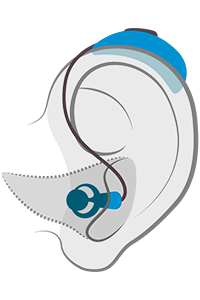
Receiver-in-canal (RIC) hearing aids—also known as receiver-in-the-ear (RITE) devices—are similar to behind-the-ear models in that most of the main components (the battery, microphones, and digital processor) sit in a small casing that rests behind the ear. A thin wire extends from this casing to the receiver (speaker), which is placed directly in the ear canal. Separating the receiver from the other components allows the behind-the-ear portion to remain compact, lightweight, and discreet. RIC hearing aids typically include wireless connectivity, offer rechargeable battery options, and are now available in waterproof designs. They are commonly recommended for individuals with moderate to severe hearing loss.

Why Should I Consider Digital, Prescriptively Fit Hearing Aids

An analog hearing aid amplifies sound so your ear receives it at a louder volume. A digital hearing aid digitizes the sounds you hear. That means it goes the extra step of eliminating background noises and frequencies that interfere with the sounds you’re trying to focus on. An analog hearing aid acts as a microphone and speaker, but digital hearing aids can perform more complex functions – such as separating speech from background noise and changing the frequency of sounds to make them more easily discernible and pleasing to the ear.

Digital hearing aids have many benefits over analog hearing aids including:

  • Digital hearing aids enhance the sound of speech, and greatly reduce bothersome background noise, to ensure you hear the person talking to you.
  • Digital hearing aids are better able to eliminate feedback – the loud ringing sound that sometimes emanates from an analog hearing aid.
  • The volume level of a digital hearing aid automatically adjusts to changes in the environment so you don’t have to make manual adjustments.

Bluetooth Hearing Aids

Most hearing aid manufacturers produce hearing aids that utilize Bluetooth technology to connect with smartphones, tablets and other capable devices. Bluetooth technology provides these capabilities without overly draining battery life, which can be important if this is a feature you anticipate using often.

Wireless Hearing Aids

Most modern hearing aids don’t feature any visible wires, cables, or cords. The term “wireless” indicates that the hearing aid can communicate with other electronic devices – including smartphones, computer tablets, smart TVs and streaming devices. If you have two hearing aids, they are also able to communicate with each other wirelessly to preserve the important localization cues of speech and environmental sounds. Non-wireless hearing aids are unable to communicate with other electronic devices or receive streaming audio.

Wireless hearing aids allow you to:

  • Hear speech, music or sounds in both ears simultaneously, even if the sound was initially picked up by only one of the hearing aids.
  • Change the volume in both hearing aids by simply pressing a button.
  • Exclude any unwanted ambient noise in the room that may interfere with comfortable listening.
  • Create custom settings for unique sound environments – such as a noisy restaurant or busy shopping mall.
  • Stream television shows, movies, internet radio stations and podcasts directly to the hearing aids without static or distortion.
  • Adjust the volume of a television without increasing the volume for other listeners (though you may need a streaming accessory).
  • Increase the clarity of speech or music over unwanted background noise.

Add a remote control to adjust the hearing aid volume, or switch between electronic devices that provide streaming music or sound.

How Wireless Hearing Aids Can Help

Rechargeable Hearing Aids

Many hearing aids today come with rechargeable batteries, which means you don’t have to replace tiny batteries on a regular basis. You simply place your hearing aids in a charging dock at night, and they’ll be powered up and ready to go the next day. Rechargeable devices can be easier to handle and are often more convenient for people who don’t want to keep buying and swapping out batteries.

Next Steps

If you are experiencing difficulty hearing or understanding speech, a comprehensive hearing evaluation is the first step toward better hearing and brain health. We will assess your hearing, discuss your communication needs, and recommend treatment options tailored to your lifestyle and hearing goals.

If hearing aids are appropriate, we will help you select the technology best suited to your needs, provide individualized fitting and programming, and support you through ongoing follow-up care. Our goal is to help you stay connected to the people, activities, and moments that matter most while supporting lifelong hearing and cognitive health.

If you have questions, we have answers. Visit our Hearing Aid FAQs or contact us today.